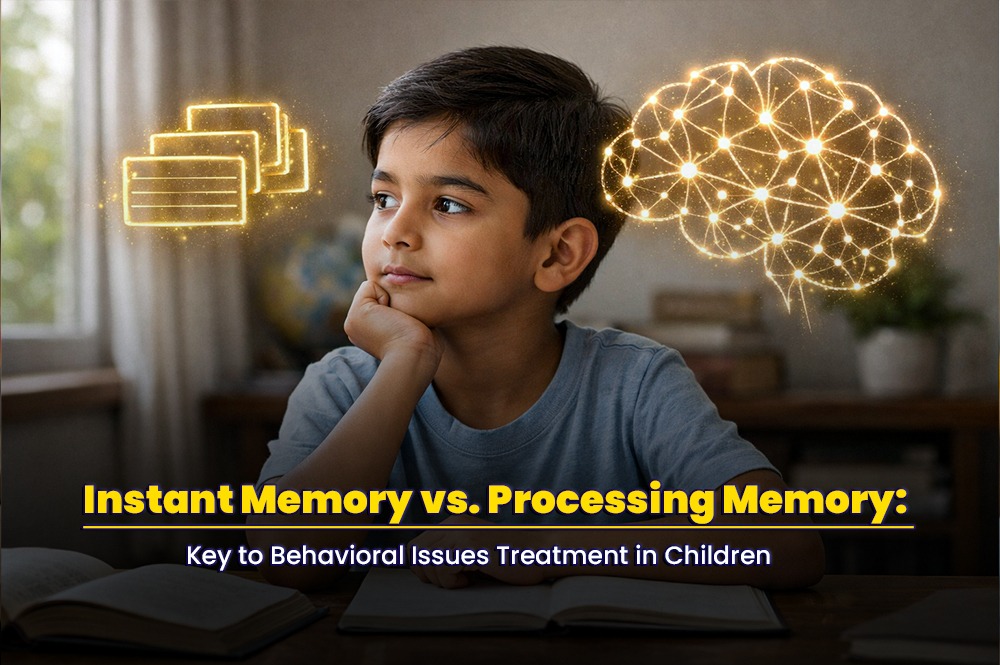
Parents often express pride when they say, My child remembers everything. Once they read it, it is fixed in their mind. Teachers may even add, Explain it once, and they can repeat it perfectly.
But here is something important to understand: remembering and truly understanding are not the same thing.
At Manovaidya, the No.1 Autism Treatment Clinic, we believe in nurturing the mind holistically, addressing both Instant Memory and Processing Memory for overall child growth, especially when dealing with Behavioural Issues Treatment in Children. Let us explore how both play critical roles in development and why understanding the difference matters.
What Is Instant Memory?
Instant memory refers to the ability to quickly memorize and recall information. It works like a quick snapshot for the brain, storing details fast and pulling them up when needed.
For example:
- A child memorizes a poem after hearing it once or twice.
- They repeat a phone number right after hearing it.
- They remember every line of a favorite movie.
Instant memory is useful for:
- Memorizing facts such as spelling words or multiplication tables
- Performing well in fact based tests
- Learning through repetition
While strong instant memory may look like high intelligence, it is only one part of development. Remembering facts alone is not enough, especially when addressing Behavioural Issues Treatment in Children.
What Is Processing Memory?
Processing memory goes beyond memorization. It involves understanding, analyzing, and applying information in meaningful ways.
For example:
- Understanding the reason behind events, not just the details
- Applying knowledge in new situations
- Solving problems and thinking logically
A child with strong processing memory:
- Thinks deeply
- Connects ideas
- Applies learning to real life situations
Processing memory may take more time but leads to deeper and long lasting understanding, especially in Behavioural Issues Treatment in Children.
A Simple Example
If a child learns about the water cycle:
- A child with strong instant memory memorizes terms like evaporation, condensation, and precipitation and can repeat the definitions accurately.
- A child with strong processing memory explains why rain happens, predicts changes if temperature increases, and connects the water cycle to real weather patterns.
Both may score well in factual tests. However, the child with stronger processing memory usually performs better in application based situations, which is essential in Behavioural Issues Treatment in Children.
Why Parents Get Confused
Parents often notice:
- Quick answers
- Fast memorization
- High scores in factual tests
This may lead to the conclusion that the child is very intelligent.
However, the same child may struggle with:
- Word problems
- Critical thinking questions
- Applying concepts in different contexts
The reason is simple. Instant memory and processing memory are different abilities. One supports recall, while the other supports understanding and application, especially in Behavioural Issues Treatment in Children.
Is Instant Memory Less Important?
No. Instant memory is important for:
- Learning languages
- Remembering formulas and definitions
- Performing well in memory based exams
- Building a strong knowledge foundation
However, as education becomes more concept focused, memorization alone may create challenges. Higher grades demand reasoning and application. This shift is crucial in Behavioural Issues Treatment in Children.
Why Processing Memory Becomes More Important
As children grow, learning focuses on:
- Critical thinking
- Logical reasoning
- Problem solving
- Real life application
Processing memory supports flexibility and stable learning. This depth of thinking is essential in Behavioral Issues Treatment in Children.
How to Strengthen Processing Memory
Ask Why and How Questions
Instead of asking Did you memorize it, ask Why does this happen or How does this work.
- Encourage Explanation
Ask your child to explain concepts in their own words. - Use Real Life Examples
Help connect lessons to daily situations. - Play Thinking Games
Use puzzles, riddles, and strategy games. - Allow Mistakes
Mistakes are part of learning. Give time to think without pressure.
An Emotional Perspective
Some children take more time to respond because they think deeply before answering. They are not slow. They are thoughtful.
Children with strong instant memory are often praised for speed. However, focusing only on speed may reduce deeper understanding. In Behavioral Issues Treatment in Children, understanding matters more than speed.
Final Thoughts
At Manovaidya, the No.1 Autism Treatment Clinic, we believe intelligence is not only about how fast a child remembers information. It is about how they understand, process, and apply it.
Some children memorize quickly. Others take more time but develop strong analytical skills.
The goal is to nurture both types of memory. Instant memory builds knowledge. Processing memory connects and applies it meaningfully, especially in Behavioural Issues Treatment in Children.
If your child remembers everything, that is wonderful. But ask this important question: Do they truly understand what they remember?
Because lasting growth is built on understanding, not just recall.

.jpeg)