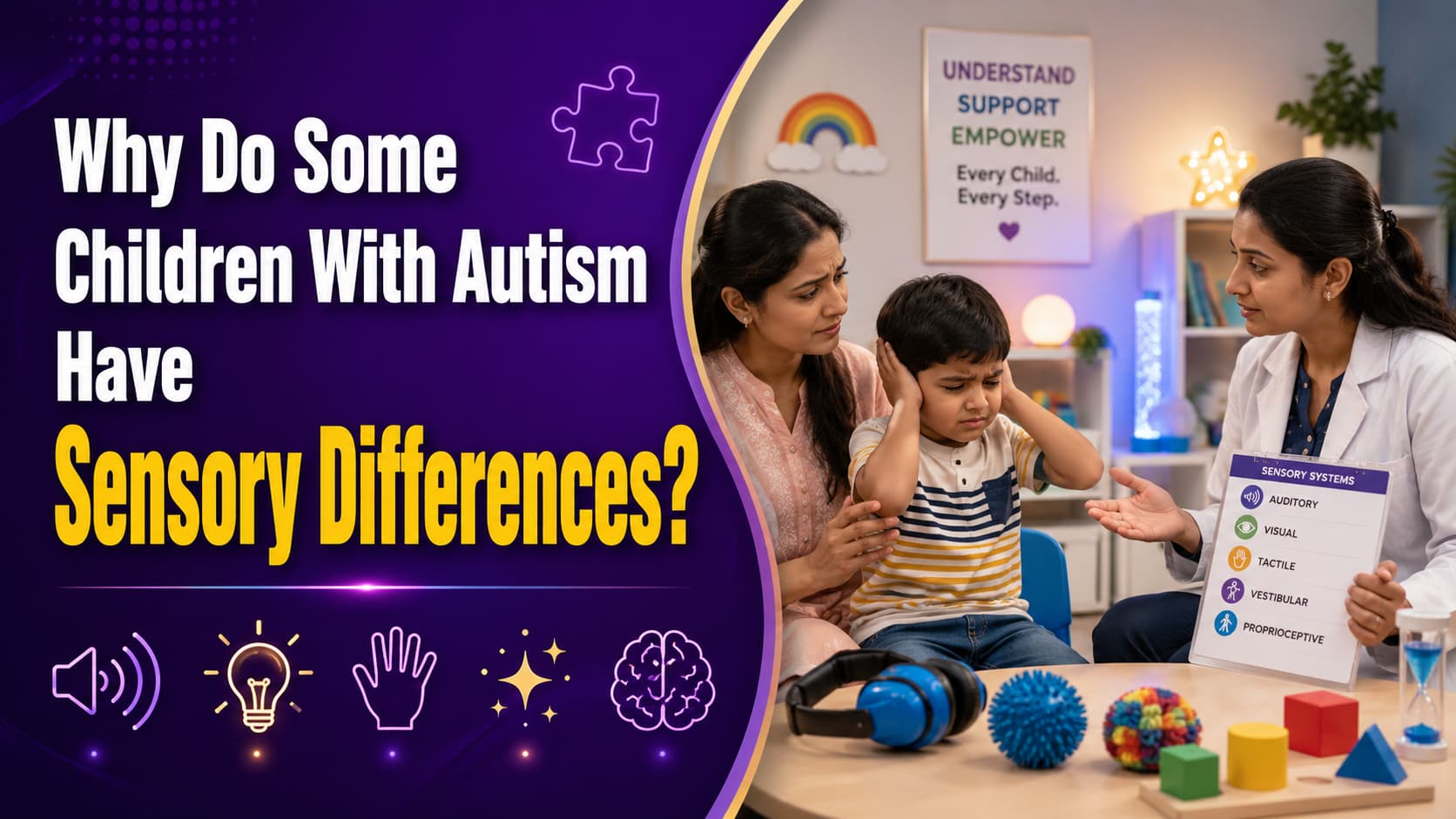
When Small Sounds Feel Too Big for Your Child
Your child covers their ears when the mixer starts.
They cry in crowded places.
They refuse certain clothes.
They may avoid touch.
Or sometimes, they keep spinning, jumping, smelling objects, or watching lights again and again.
As a parent, it feels confusing.
“Why does my child react so much?”
“Is this behaviour?”
“Is this autism?”
These reactions may be connected with autism sensory issues.
And when parents do not understand this, they often feel helpless.
But your child is not doing this to trouble you.
Their brain may be processing the world differently.
What is the Autism Sensory Issue?
Autism sensory issue means a child’s brain processes daily sensations differently.
These sensations can be sound, touch, light, smell, taste, movement, balance, or body pressure.
For example, a normal mixer sound may feel too loud for the child.
A simple clothing tag may feel painful.
A crowded place may feel overwhelming.
Some children avoid sensory input.
Some children seek more sensory input like jumping, spinning, or crashing into cushions.
So, autism sensory issues are not “bad behaviour.”
They are signs that the child’s nervous system is finding it difficult to process the world smoothly.
Have you noticed your child reacting strongly to sounds, clothes, food textures, or crowded places?
That may be an important sign to observe.
Why Do Children With Autism Have Sensory Differences?
Children with autism may have sensory differences because their brain and nervous system process sound, touch, light, smell, taste, movement, and body awareness differently.
For parents looking for the best autism doctor in India, a structured autism treatment India approach should include brain development, gut–brain connection, sensory integration, Ayurveda autism treatment, and long-term autism improvement.
Understanding sensory differences requires looking beyond behaviour alone. Brain development, sensory processing, emotional regulation, daily routines and overall wellbeing can all influence how a child responds to the world around them.
Dr Ankush Garg (Bio)

Dr. Ankush Garg is an Autism, ADHD, Child Development & Mental Health Specialist in India, Founder of Manovaidya and Creator of the Neuro-Ayurveda Development System.
His work focuses on developmental, behavioural and mental wellness concerns through a structured Neuro-Ayurveda approach that emphasizes personalized guidance, family-centred support and long-term wellbeing.
Quick Signs Checklist for Parents
Use this simple checklist to observe your child gently:
✔ Covers ears during loud sounds
✔ Cries in crowded places
✔ Avoids haircuts or nail cutting
✔ Refuses certain clothes or tags
✔ Eats only selected food textures
✔ Keeps smelling objects
✔ Spins round and round often
✔ Jumps or runs continuously
✔ Crashes into sofa, bed, or people
✔ Does not like touch or hugs
✔ Gets irritated by bright lights
✔ Finds it hard to sit calmly
✔ Overreacts to small changes
✔ Puts objects in mouth repeatedly
✔ Gets upset during bathing or brushing
If you notice many of these signs again and again, it may be related to autism sensory issues.

Signs of Sensory Issue Parents Should Notice
Parents should notice patterns, not just one-time reactions.
Every child may dislike something sometimes.
But when the same reaction happens repeatedly, it becomes important.
For example, if your child always covers ears during sounds, always avoids certain clothes, or always cries in crowded places, this may show sensory sensitivity.
Some children also show sensory seeking behaviour.
They may jump too much.
Spin again and again.
Run without stopping.
Touch every object.
Smell toys or food.
Push their body against walls or furniture.
These signs tell us that the child’s brain may need extra sensory input to feel regulated.
There are also mixed signs.
A child may avoid loud sounds but love spinning.
A child may hate touch but enjoy deep pressure.
A child may refuse some foods but smell everything.
This is why parents should observe carefully.
Do not only think, “My child is stubborn.”
Ask gently, “Is my child overwhelmed?”
When autism sensory issues are understood early, parents can support the child better with calm routines, sensory guidance, gut support, brain nourishment, and structured autism treatment India.
Small understanding can reduce big stress for both child and parent.
Types of Autism Sensory Issues Parents Should Understand
Not all sensory issues look the same.
Some children become overwhelmed by sensory input, while others actively seek sensory experiences.
Understanding the type of sensory difference can help parents support their child more effectively.
Sound Sensitivity
Some children may cover their ears during mixer sounds, vacuum cleaners, school assemblies, traffic noise or crowded places.
Touch Sensitivity
Some children may dislike certain clothes, clothing tags, haircuts, nail cutting, tooth brushing or physical touch.
Food Texture Sensitivity
Some children may refuse foods because of texture rather than taste. They may only eat foods with a specific texture or consistency.
Visual Sensitivity
Bright lights, flashing screens or crowded visual environments may feel overwhelming for some children.
Movement Seeking Behaviour
Some children may constantly jump, spin, run, climb or seek movement because their sensory system is looking for additional input.
Smell Sensitivity
Some children may react strongly to smells, while others may repeatedly smell objects, toys or food items.
Every child is different. This is why sensory patterns should be understood individually rather than compared with other children.
Why Parents Feel Confused About Sensory Behaviour
Many parents first think sensory reactions are tantrums.
A child cries when someone touches their hair.
A child refuses shoes.
A child becomes restless in malls.
A child eats only selected foods.
A child keeps jumping or running.
A child gets angry when routine changes.
Families visiting Manovaidya often say, “Doctor, we thought our child was just stubborn.”
But slowly they understand that autism sensory issues are not simple stubbornness.
The child may be overwhelmed.
Their brain may not be able to filter sensory input properly.
For example, a sound that feels normal to us may feel too loud to the child.
A light touch may feel irritating.
A crowded room may feel like pressure from all sides.
Have you noticed this in your child?
This is why parents need guidance, not judgement.
Why Many Autism Treatment Plans Miss Sensory Needs
Many treatment plans focus only on speech or behaviour.
Speech therapy is started.
Occupational therapy is started.
Special education is started.
These therapies are important.
But if the child has strong autism sensory issues, learning can become difficult.
Imagine trying to learn while a loud alarm is ringing in your ears.
That is how some children may feel in normal environments.
If sensory overload is not addressed, the child may cry, run away, shout, bite, cover ears, or avoid tasks.
Parents may think the child is not cooperating.
But actually, the child may be struggling internally.
This is why only external therapy may not be enough.
A complete autism treatment India plan should understand why the child is reacting, not just what the child is doing.
The Core Belief Behind Autism Sensory Improvement
“Therapies alone lead to limited improvement in autism unless the internal brain and gut system are healed.”
"Many parents searching for the best autism doctor in India eventually reach Dr Ankush Garg after trying multiple therapies without clarity."
This line is very important for autism sensory issues.
Because sensory problems are not only outside behaviour.
They are connected with brain processing, nervous system balance, gut health, sleep, attention, emotions, and overall regulation.
If the child’s internal system is overloaded, sensory reactions may become stronger.
What Are Autism Sensory Issues?
Autism sensory issues mean the child reacts differently to sensory input.
These inputs may include:
Sound.
Touch.
Light.
Smell.
Taste.
Movement.
Balance.
Body awareness.
Some children are over-sensitive.
They may cover ears, avoid touch, hate haircuts, dislike labels on clothes, or cry in noisy places.
Some children are under-sensitive.
They may jump a lot, spin, crash into things, smell objects, put things in the mouth, or seek deep pressure.
Some children show both.
They may avoid sound but seek movement.
They may hate certain textures but crave spinning.
This is why parents should not compare one child with another.
Every child’s sensory profile is different.
At Manovaidya, parents are guided to observe these patterns carefully.
Because when you understand the pattern, you can guide the child better.
How Sensory Differences Affect Speech, Behaviour and Learning
Sensory overload can affect many areas of development.
If the child is overwhelmed by sound, they may not listen properly.
If touch feels uncomfortable, they may resist therapy activities.
If movement needs are high, they may not sit in one place.
If food texture is difficult, eating becomes stressful.
If the child cannot process body signals properly, they may keep jumping or crashing.
This is why autism sensory issues can directly affect speech, attention, learning, sleep, and behaviour.
Parents often say, “My child knows things, but does not respond.”
Sometimes, the child may not respond because sensory overload is blocking attention.
Through Manovaidya, families are helped to understand this connection between sensory processing and development.
The goal is not to force the child.
The goal is to regulate the child.
Why Brain, Gut and Behaviour Must Be Seen Together
Sensory processing happens in the nervous system.
But the nervous system is also affected by sleep, digestion, food, toxins, emotions, and daily routine.
If the child is constipated, irritable, or sleeping poorly, sensory reactions may increase.
If digestion improves, sleep becomes better, and the child becomes calmer, sensory tolerance may also improve.
Have you noticed your child becoming more sensitive when tired or hungry?
This is common.
This is why Ayurveda autism treatment looks at the child as a whole.
Not just the symptom.
Not just the behaviour.
Manovaidya follows a structured approach where brain, gut, behaviour, sensory response, and development are understood together.
This makes autism treatment India more complete and more practical for parents.
How Ayurveda Autism Treatment Looks at Sensory Differences
Ayurveda autism treatment focuses on internal balance.
In simple words, the child’s body and brain need calmness, nourishment, and better regulation.
If the gut is weak, nourishment may not reach the brain properly.
If the nervous system is overactive, the child may remain restless.
If sleep is poor, sensory reactions may become stronger.
If behaviour is not guided gently, the child may feel more anxious.
So the treatment should support the inside and outside together.
This is why many parents searching for the best autism doctor in India want a doctor who understands autism sensory issues beyond normal behaviour control.
They want a plan that supports real autism improvement.
Neuro-Ayurveda Autism Development System
At Manovaidya, Dr Ankush Garg follows a structured system called:
Neuro-Ayurveda Autism Development System
This system includes these exact pillars:
✔ Brain nourishment
✔ Gut repair
✔ Neural network activation
✔ Sensory integration
✔ Behaviour guidance
This system is designed to support the child step by step.
It does not look at autism sensory issues as isolated symptoms.
It looks at the child’s full developmental system.
Brain nourishment supports learning readiness.
Gut repair supports internal comfort.
Neural network activation supports better response.
Sensory integration supports regulation.
Behaviour guidance supports daily life.
What Does a Personalized Sensory Care Plan Include?
1. Gut Detoxification
Gut detoxification is the first step.
Many children with autism have constipation, bloating, poor appetite, food sensitivity, or irregular digestion.
When gut health is weak, the child may feel uncomfortable from inside.
That discomfort may increase irritability and sensory reactions.
Gut support helps prepare the body for better autism improvement.
2. Brain Nourishment
Brain nourishment supports attention, memory, learning, speech, and emotional control.
For children with autism sensory issues, brain nourishment may help the nervous system become more stable over time.
The goal is not only to reduce reactions.
The goal is to support better processing.
3. Neural Activation
Neural activation means supporting weak brain pathways.
When neural connections become more active, the child may respond better to instructions, eye contact, speech attempts, and sensory activities.
This can support autism improvement in a more structured way.
4. Attention and Behaviour Improvement
Attention and behaviour improve when the child feels regulated.
A child who is less overwhelmed can sit better.
Listen better.
Play better.
Try therapy better.
This is why sensory integration and behaviour guidance must go together.
An autism treatment India plan should support the child’s daily functioning, not just reduce one symptom.
What Happens During Sensory Evaluation?
During consultation, parents should share small details.
Does the child cover ears?
Does the child avoid touch?
Does the child like spinning?
Does the child eat only certain textures?
Does the child cry during haircuts?
Does the child run in open spaces?
Does the child hate crowds?
At Manovaidya, these observations help in understanding the child’s sensory profile.
An expert does not only see behaviour.
They try to understand the trigger behind behaviour.
This is how autism sensory issues can be guided better.
Case Study Style Proof
One family consulted Dr Ankush Garg regarding a child who showed strong sound sensitivity, poor sitting tolerance, hyperactivity and speech delay. Parents reported that the child frequently covered his ears in public places and became distressed during routine changes.
Over time, the family focused on improving sleep, digestion, daily regulation and developmental support alongside ongoing therapies. Parents gradually reported better participation, improved sitting tolerance and increased responsiveness during daily activities.
Every child is different, but this example highlights the importance of understanding the broader developmental picture rather than focusing on a single symptom.
Autism Improvement Timeline for Sensory Differences
Common Mistakes Parents Make With Sensory Issues
Parents often make mistakes because no one explains sensory needs properly.
Common mistakes include:
- Thinking sensory reactions are only tantrums
- Forcing the child into overwhelming places
- Ignoring sleep and digestion
- Depending only on therapies
- Not tracking sensory triggers
- Changing treatment too quickly
- Giving random supplements
- Ignoring food texture problems
- Comparing the child with other children
- Not choosing a structured roadmap
Autism sensory issues need patience.
Pressure can make reactions worse.
Guidance can make the journey easier.
What Can Parents Do at Home?
Parents can support the child with small steps.
Keep a calm routine.
Avoid sudden loud sounds.
Observe food reactions.
Track sleep.
Reduce screen overload.
Give the child time to respond.
Use simple instructions.
Do not force eye contact.
Celebrate small progress.
Families visiting Manovaidya are often guided to observe daily patterns.
Because home routine plays a big role in autism improvement.
The same Neuro-Ayurveda principles used for developmental concerns are also applied at Manovaidya in areas such as ADHD, behavioural concerns, teen mental health, adult mental health, women’s emotional wellbeing and senior mental health support.
Is Your Child’s Sensory Care Complete?
Use this self-check tool:
✔ Is gut treatment happening?
✔ Is brain nourishment given?
✔ Is behaviour guided?
✔ Is progress tracked?
If your answer is “No” to more than two questions, the plan may be incomplete.
Read more about autism treatment here: Best autism treatment doctor in Delhi NCR
For early signs and evaluation, this guide on Best autism doctor for early diagnosis can help parents take the right step.
If your child has speech delay with sensory concerns, this blog on Autism doctor for child care may also help you understand the bigger picture.
How Can Parents Take the Next Right Step?
If your child frequently covers their ears, avoids touch, struggles with food textures, seeks excessive movement or experiences frequent sensory overload, a structured developmental evaluation may help provide greater clarity.
Understanding sensory patterns early often helps families make more informed decisions regarding support, routines and developmental planning.
The goal is not simply to manage behaviour.
The goal is to understand the child more clearly.
"Many parents searching for the best autism doctor in India eventually reach Dr Ankush Garg after trying multiple therapies without clarity."
If you are searching for the best autism doctor in India and feel confused after trying multiple therapies, this is the right time to take a structured approach. You can book a consultation with Dr Ankush Garg at Manovaidya and understand your child's condition in depth.
Every day you delay… becomes a development gap tomorrow.
The same Neuro-Ayurveda principles used for developmental concerns are also applied at Manovaidya in areas such as ADHD, behavioural concerns, teen mental health, adult mental health, women’s emotional wellbeing and senior mental health support.
Call Us: +91-7823838638 Email: manovaidya2@gmail.com
Frequently Asked Questions
Progress can be seen in talking making eye contact paying attention being ready to learn, behaving, processing sensations and doing things.
Every child is unique.
Progress depends on the childs profile, age, strengths, support system and how consistent the help is.
The goal is not to change who the child is.
The goal is to help the child develop skills and improve their independence and reach their potential over time.
Structured autism treatment in India, especially approaches that work on both brain and gut, have shown better improvement outcomes.
A brain development and gut–brain connection based autism treatment India approach can help parents understand these patterns and support autism improvement.
When autism treatment India includes sensory integration, brain development and gut–brain connection, and Ayurveda autism treatment, autism improvement may become more visible over time.
This may be part of autism sensory issues. A structured autism treatment India plan focused on brain development and gut–brain connection may help the child become more regulated and support autism improvement.
Sensory differences are not the same for every child and can vary significantly from one individual to another. Understanding a child's sensory profile is often an important part of developmental support because sensory processing can influence communication, behaviour, attention, learning and daily functioning. A structured assessment can help families better understand these patterns and identify practical strategies to support their child's comfort, participation and overall development.
.jpg)
.jpg)

.jpg)
.jpg)


.jpg)